How to Do Dog CPR? Vet-Verified Step-By-Step Guide



Although dogs are less likely than humans to suffer heart attacks, there are still occasions when an owner might need to give their dog cardiopulmonary resuscitation (CPR). It should only ever be given when the dog has no pulse, or it could cause serious damage, and you should be prepared to get the dog to a vet or animal hospital immediately after successful CPR. CPR can be useful if your dog has choked and stopped breathing or after electrocution.

The Step-By-Step Guide on How to Perform Dog CPR
The exact process does differ according to the size of the dog, but the general steps are the same and as follows:
1. Check for Breathing and Circulation
You shouldn’t administer CPR if your dog is breathing. Look at its chest and see if there are any thoracic movements. You can check the pulse by locating the femoral artery on the inside of the rear leg. Put your hand on the inside of the leg, at approximately the mid-thigh position, and hold firmly but not too tightly. If there is a pulse, take your dog to the vet immediately. If there is no pulse, then there isn’t time to get to a vet, and you should administer CPR if it is appropriate. If your dog has a pulse but is not breathing, you can perform artificial respiration or rescue breaths but should not perform CPR.

2. Position Your Dog
If you need to perform CPR, you need to get your dog into a position that allows you to perform CPR on the heart. Some breeds with flat chests, like Bulldogs, can be laid on their back. Otherwise, lay your dog on its right-hand side.
3. Clear the Airway
Open your dog’s mouth and pull its tongue forward so it is against the back of its teeth. Check for any obstructions further down the throat or in the back of the mouth.

4. Position Your Hands
For large dogs of 25 pounds or heavier, lock your elbows with arms straight and put one hand over the other. Place your hands over the widest part of the dog’s chest. For smaller and deep-chested dogs, locate the heart by bending their top front leg, and where the elbow meets the chest is roughly where the heart is. Place your hands, one on top of the other with your elbows locked, in this position.
5. Start Compressions
Keep your shoulders above your hands and your arms straight, and make quick compressions about a third of the chest width. Bend at your waistline, and remember to keep your elbows locked. Please make sure that you are not putting your weight on the dog the whole time. You should be allowing its chest to expand and fill up with air after each contraction. You should administer approximately two compressions every second. You can either keep time to Stayin’ Alive by the Bee Gees or Another One Bites the Dust by Queen.

6. Administer Rescue Breaths
If you’re performing CPR by yourself, stop after 30 compressions to administer the rescue breaths. If you have somebody with you, one of you should continue to perform the compressions while the other administers two rescue breaths every 7 seconds or so.
It is very important to make sure the dog’s neck is straight so that there is a straight line from the nose to the lungs. Close the dog’s mouth and blow two times into the nose. When giving a rescue breath, it is important to consider the size of the dog; do not blow large amounts of air into a small dog. After administering two rescue breaths, perform 30 more chest compressions.
7. Check for a Pulse
If you are working alone, check for a pulse while you give the rescue breath. Alternatively, the second person can check the pulse every two minutes, and this is a good time to swap roles. If you find a pulse, stop administering CPR and get the dog to a vet as quickly as possible.

8. Continue
If there is still no pulse, continue with the process, administering both compressions and rescue breaths and regularly checking for a pulse. Generally, you can continue with the process for about 20 minutes. If there is no response after this time, CPR has been unsuccessful.
9. Get to a Vet
If you do find a pulse at any point in the process, stop giving CPR and rescue breaths and immediately get your dog to a vet. They will look for the cause and should be able to stabilize your dog.
Final Thoughts
Hopefully, you will never have to administer CPR to your dog, but if the need arises, knowing how to do it can be lifesaving. Act quickly, follow the guidelines above, and consider attending a pet first aid course to help master this and other life-saving procedures for your pets.
Sources
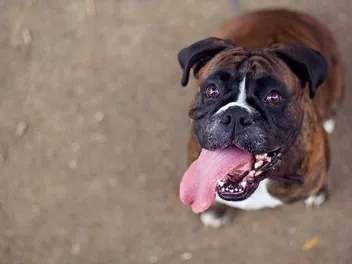
Featured Image Credit: Engin_Akyurt, Pixabay
Expert dog care, straight to your inbox
News, insights, expert advice, and everything dog.

No spam — unsubscribe anytime.
By signing up, you agree to our Terms & Conditions and Privacy & Cookies Policy.
How useful was this post?
Click a star to rate. You can leave written feedback afterwards. (We read all feedback.)
Nicole has loved animals of all sizes her whole life so it's no wonder she has dedicated her career to helping them through what she loves best: learning, writing, and sharing knowledge with others. She’s the proud mom of two dogs, a cat, and a human. With a degree in Education and 15+ years of writing experience, Nicole wants to help pet parents and pets around the planet to live happy, safe, and healthy lives.